2.4 GHz vs 5.8 GHz UAV Antenna: Which Band Should You Choose?
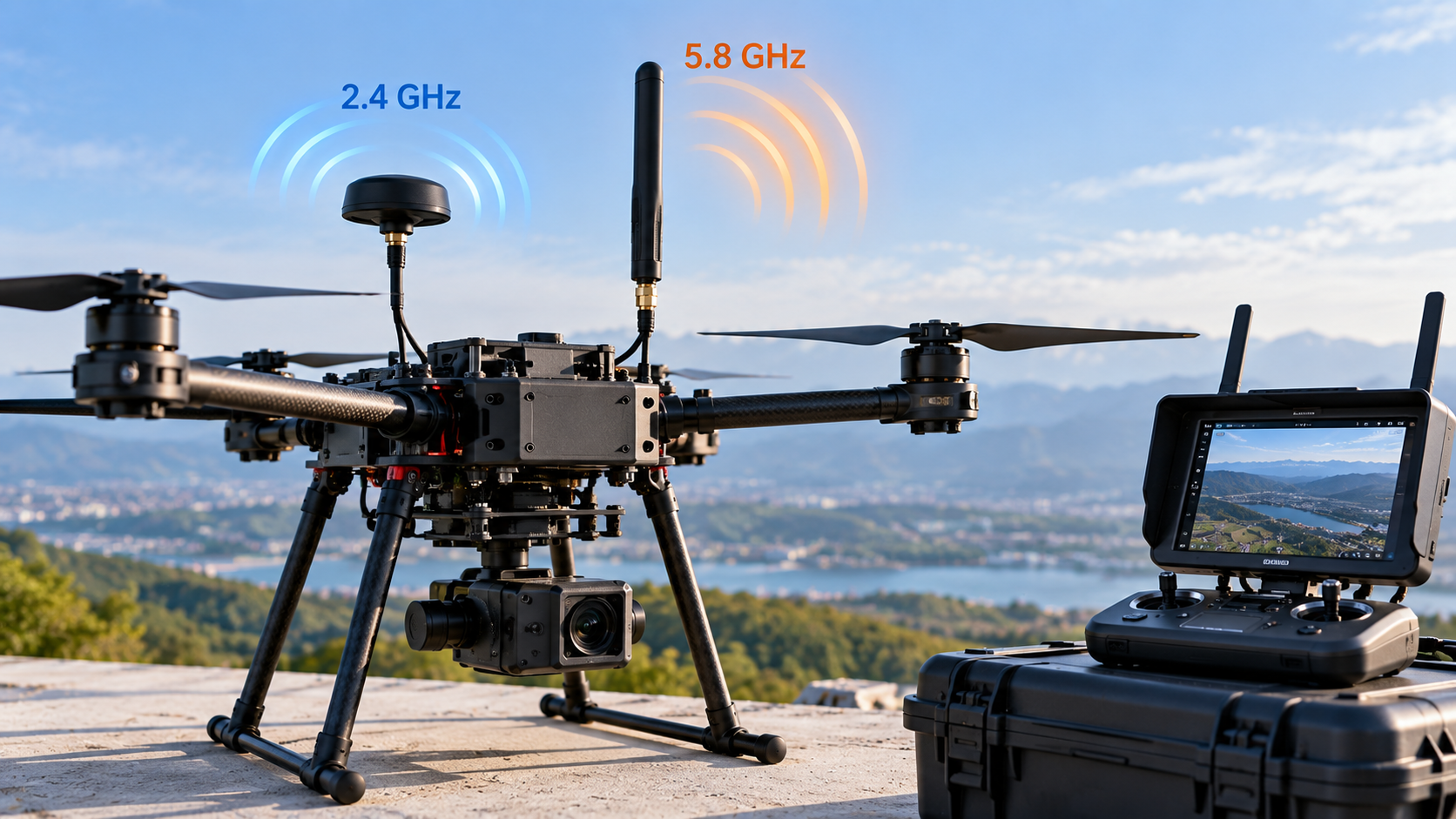
For a UAV radio link, 2.4 GHz and 5.8 GHz are not interchangeable choices. At the same transmit power, distance, antenna gains and propagation conditions, 2.4 GHz has lower free-space path loss than 5.8 GHz, while 5.8 GHz uses a shorter wavelength that can support more compact antenna structures. The better band is therefore the one that matches the aircraft radio, ground station, regulatory environment, interference conditions, antenna polarization and required link geometry.
Do not choose the band from a “long range” or “high gain” label alone. A well-integrated 5.8 GHz link can outperform a poorly integrated 2.4 GHz link, and the reverse is also true. Treat the antenna, radio, cable, mounting position and ground-side antenna as one RF system.
2.4 GHz vs 5.8 GHz UAV Antenna: Quick Comparison
| Selection Factor | 2.4 GHz | 5.8 GHz |
|---|---|---|
| Free-space path loss at the same distance | Lower | Higher |
| Wavelength | Longer | Shorter |
| Antenna element size for similar electrical length | Typically larger | Typically smaller |
| Radio compatibility | Must match a 2.4 GHz radio path | Must match a 5.8 GHz radio path |
| Interference environment | Site-dependent | Site-dependent |
| Regulatory limits | Region- and application-dependent | Region- and application-dependent |
| Best use | When the complete 2.4 GHz link budget and integration fit the mission | When the complete 5.8 GHz link budget and integration fit the mission |
Why Does 2.4 GHz Usually Have Lower Path Loss?
Free-space path loss increases with frequency when distance is held constant. That means a 5.8 GHz signal experiences more free-space loss than a 2.4 GHz signal over the same distance when all other link parameters are equal.
This does not mean that a 2.4 GHz UAV system always has greater real-world range. Transmit power, receiver sensitivity, antenna gain and pattern, polarization, interference, cable loss, aircraft orientation and the ground-station antenna can outweigh the frequency difference. Use a complete link budget instead of frequency alone.
Why Can 5.8 GHz Antennas Be More Compact?
Antenna dimensions are related to wavelength. Because 5.8 GHz has a shorter wavelength than 2.4 GHz, a resonant element for 5.8 GHz can generally be smaller for a comparable electrical length.
That can help on space-constrained UAVs, but compact size is not automatically an RF advantage. The smaller antenna still needs appropriate efficiency, bandwidth, polarization, radiation pattern, connector and placement for the actual airframe.
Is 2.4 GHz Better for Long-Range UAV Links?
Not automatically. 2.4 GHz has a propagation advantage in free space relative to 5.8 GHz under equal conditions, but the usable range of a UAV link comes from the total link budget and installation.
A high-loss cable, poor antenna orientation, polarization mismatch, blocked radiation pattern or noisy channel can reduce the performance of either band. For a long-range design, compare the actual radio output power, receiver sensitivity, antenna gains, feed losses and expected flight geometry before choosing the band.
Is 5.8 GHz Better for FPV Video?
5.8 GHz is widely used in FPV and UAV video systems, but the antenna should be selected to match the specific video transmitter or air unit rather than the application label. Some modern systems use 2.4 GHz, 5.8 GHz or dual-band operation.
For a 5.8 GHz video link, verify the antenna’s actual frequency coverage and polarization. A circularly polarized transmitter antenna should be paired with a compatible polarization on the receiving side. RHCP and LHCP are not interchangeable if the goal is polarization matching.
Does Polarization Matter More Than the Frequency Choice?
Both matter, but polarization mismatch can create a major avoidable loss in a UAV link. Linear antennas should be oriented with the expected polarization relationship in mind, while circularly polarized systems should use compatible handedness.
Aircraft roll, pitch and yaw can change the relative orientation between the airborne and ground antennas. This is one reason UAV designers should evaluate the radiation pattern and polarization behavior through representative flight attitudes rather than only testing the aircraft while stationary on a bench.
Should the UAV Antenna Be Omnidirectional or Directional?
The airborne antenna is often selected for broad coverage because the aircraft changes position and orientation. The ground side may use an omnidirectional antenna, a directional antenna or a tracking arrangement depending on the mission.
Higher directional gain can extend the link budget in a chosen direction, but it narrows the useful beam. On the aircraft, very high gain can also create deep coverage variations outside the main radiation region. Review pattern shape, not just peak dBi.
When Does a Dual-Band 2.4/5.8 GHz UAV Antenna Make Sense?
A dual-band antenna is useful when one antenna assembly must support both 2.4 GHz and 5.8 GHz radio paths and the product provides verified coverage for both ranges. This can simplify mechanical integration, but it does not remove the need to map each RF chain and connector correctly.
Nova Antenna currently lists dual-band UAV/FPV antenna examples covering 2400–2500 MHz and approximately 5.1–5.9 GHz. One current IPEX model is specified for 2400–2500 MHz and 5150–5850 MHz with omnidirectional linear polarization, while another SMA model is specified for 2400–2500 MHz and 5100–5900 MHz with RHCP circular polarization. These are examples of different polarization and connector architectures, not universal recommendations.
How Should Connector Type Affect the Choice?
Connector compatibility is part of the RF design. Airborne systems may use compact IPEX-style interfaces inside the aircraft, while external FPV antennas often use SMA-family connectors. Confirm the exact mating interface, not just the connector family name.
Every adapter and coaxial section adds loss and mechanical complexity. On a lightweight UAV, also consider cable routing, strain relief and connector retention under vibration.
How Does Antenna Placement Affect 2.4 and 5.8 GHz Links?
Placement can determine whether either band works well in the final aircraft. Batteries, carbon-fiber structures, motors, electronic speed controllers, cameras, shielding and wiring can disturb the antenna environment or block part of the radiation pattern.
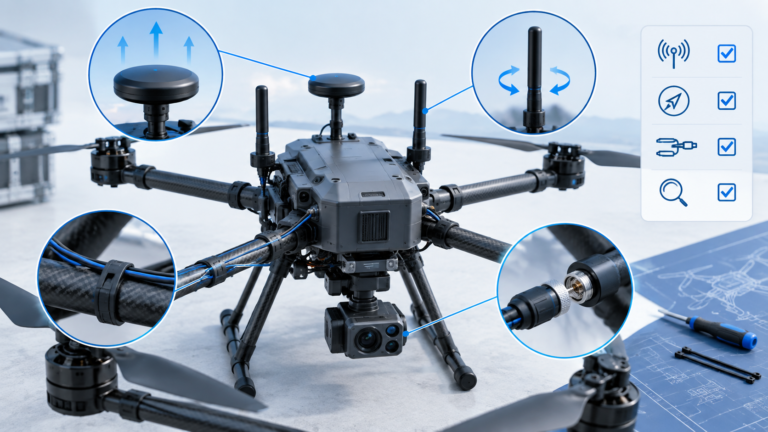
For a broader installation workflow, use the UAV antenna selection and installation checklist.
Keep the radiating element away from unnecessary conductive obstructions where the airframe permits. For a multi-antenna design, also consider spacing and coupling. Validate the antenna in the assembled aircraft because a loose antenna measured away from the airframe does not represent the installed RF system.
What About Interference at 2.4 GHz and 5.8 GHz?
Interference depends on the location, channel plan, other radios on the aircraft and nearby transmitters. Neither band is universally cleaner. A 2.4 GHz link may share spectrum with common wireless systems, while a 5.8 GHz link can also encounter other FPV, WLAN or point-to-point equipment.
Use spectrum measurements or field testing when the operating environment is important. Also check whether the UAV carries multiple radios that can desensitize each other through poor antenna spacing, harmonics or insufficient filtering.
Do Regulatory Rules Change the Decision?
Yes. Allowed frequencies, transmit power, bandwidth and operating conditions vary by country and application. Antenna gain can also affect compliance because regulatory limits may be defined using radiated power rather than transmitter output alone.
Confirm the applicable rules for the deployment region before finalizing a 2.4 or 5.8 GHz radio and antenna combination. Do not assume that a band or power level used in one market is automatically allowed in another.
2.4 GHz vs 5.8 GHz UAV Antenna Selection Checklist
- Identify every radio link. Separate command, telemetry, video and payload links instead of assuming one band serves all functions.
- Confirm the radio frequencies. Use the transmitter and receiver documentation to define the required antenna range.
- Build the link budget. Include transmit power, receiver sensitivity, antenna gain, coaxial loss and other RF components.
- Choose polarization deliberately. Match linear or circular polarization and, for circular polarization, match RHCP or LHCP.
- Review the radiation pattern. Ensure the pattern remains useful through expected aircraft attitudes.
- Check connector and cable loss. Avoid unnecessary adapters and long feed paths.
- Inspect the airframe environment. Consider carbon fiber, batteries, motors, electronics and other antennas.
- Check local regulations. Verify the allowed band, power and radiated limits for the market.
- Validate in flight conditions. Test the installed aircraft and ground station across the intended mission geometry.
Common 2.4 GHz vs 5.8 GHz UAV Antenna Mistakes
- Assuming 2.4 GHz always has longer range: lower free-space loss helps, but the complete link budget controls usable range.
- Assuming 5.8 GHz is automatically better for video: the antenna must match the actual video radio and system design.
- Ignoring polarization: mismatched polarization can waste link margin.
- Choosing only by peak gain: radiation pattern and aircraft orientation are equally important.
- Reusing a WiFi antenna without checking frequency and connector details: application labels do not guarantee fit for a UAV radio.
- Ignoring airframe materials: conductive or carbon-fiber structures can alter the installed pattern.
- Skipping regulatory review: legal operating conditions vary by region.
Which Nova Antenna Options Are Relevant?
Nova Antenna’s Drone & UAV Antennas category and 2.4GHz Drone Antennas category are current starting points for UAV antenna formats. Current dual-band product examples include a 2.4/5.8 GHz IPEX omnidirectional antenna and a 2.4/5.8 GHz RHCP SMA UAV antenna. Final selection should still be based on verified radio frequency, polarization, connector, gain pattern and airframe integration.
Review the current Drone & UAV Antennas category for available UAV antenna formats.
What Information Should You Provide for a UAV Antenna Request?
Prepare the radio or air-unit model, exact frequency range, transmit power, receiver sensitivity, required polarization, connector, cable requirement, target antenna location, aircraft materials, maximum antenna size and weight, expected flight distance and altitude, ground-station antenna type and deployment country.
With those inputs, 2.4 GHz and 5.8 GHz can be compared as complete UAV links rather than as isolated antenna labels. That leads to a more reliable engineering decision and reduces the risk of selecting an antenna that is electrically compatible but poorly matched to the mission.